
Fight the Darkness

A New Scroll of LA Jewish News
Folks,
On a holiday when we rightly have an inflated view of ourselves, much has happened to let out the joy. A first day of Chanukah attack at Australia’s Bondi Beach in Sydney killed 15. The reports of increased antisemitism in the US have been grim. Unfortunately, re-inflating us have been the holiday prices for Chanukah gifts and treats. At an LA kosher bakery this year, three cookies and three sufganiyot cost $23.10. In such an atmosphere, how do we maintain our equilibrium? First, get a grip. Don’t let your spirit go all-melted-candle. In LA, law enforcement is out watching for trouble, and reminds us to call 9-1-1 immediately, if we see “suspicious behavior or activity.” Second, getting down to the basics of celebrating the holiday, a box of Chanukah candles in still just 99 cents.
...And getting down to the basics of celebrating MegilLA, hopefully, your favorite LA Jewish news and feature source, please send a little light our way by becoming a paid subscriber today.
This issue is dedicated to my brother-in-law Alan Roselinsky, my friend since I was six, and a devoted reader of this publication. May his memory be for a blessing.
Happy Chanukah
Edmon J. Rodman
////\/\\\\
////\/\\\\
With warning lights blinking,
light your menorah
in the window?
Edmon J. Rodman
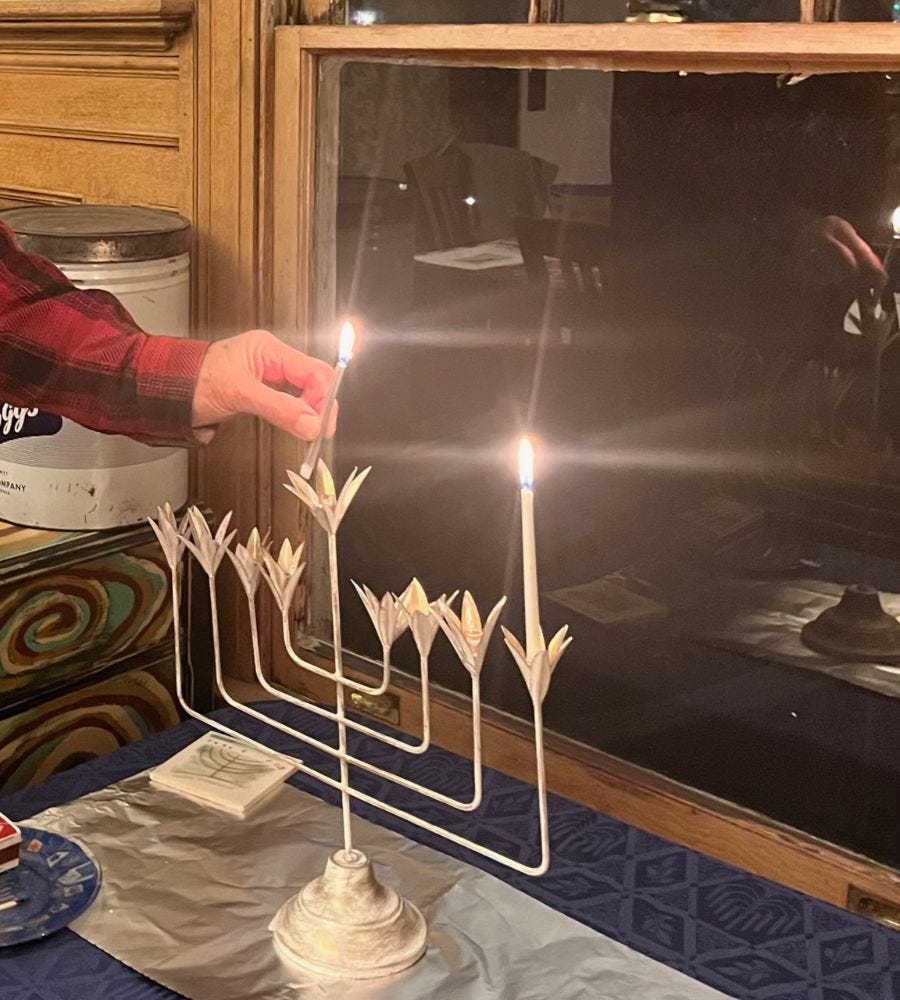
In the days before Chanukah, with anticipation of the holiday glowing in my mind, the darkening news of rising anti-Semitism in the U.S. began to filter in. As I pictured our menorah burning in its usual place — the front window of our home — a warning light began to blink.
Though Chanukah represents a victory of light over darkness — by the Maccabees over the Seleucid Empire, which resulted in the rededication of the Second Temple —a recent event, the first night of Chanukkah shootings in Australia, was causing me to rethink our window menorah lighting, turning me toward sharing our menorah kindling with only family and friends.
For 25 years we’ve lived on a block where no other signs of the Festival of Light can be seen. We’ve proudly placed our menorahs — whether lit by candle or by bulb — in our front windows, publicizing the miracle of the holiday both to our neighbors and ourselves.
Saying the blessings and lighting the candles is a mitzvah, according to the Talmud, and by doing so, we were also recognizing the blessing of our freedom of religion and expressing our Jewish identity.
In fact, it wasn’t really Chanukah for me until I walked outside and, looking at the lit menorah emanating from my own window, affirmed that we had arrived to this time once again.
Why was I worried now?
Since the previous Chanukah, though nothing had changed in our multi-ethnic and multi-denominational neighborhood, a place where non-Jewish neighbors have wished me “Happy Hanukkah” and at Passover “gut yontif.” But, since Oct. 7, the mood in our nation towards Jews had darkened.
I was worried about what had emerged from the shadows: anti-Semitic iconography online, attacks on Jewish journalists, the re-emergence of Jewish conspiracy stories, Jewish college students being confronted with swastikas. And now the slaughter of Jews celebrating Chanukah on an Australian beach.
Near LA, in Redlands on December 14, according to several news sources, a Jewish home decorated for Chanukkah was hit around 20 times in a drive-by shooting.
Was this a wise time to let our light shine?
Was it a good time to draw the light safely in and bring the flickering candles into the kitchen? After all, that’s the way my mother, who grew up in the Bronx borough of New York City in the 1930s, when anti-Semitism in America was on the rise, did it in her home.
What was I afraid of? It wasn’t as if I’m expecting a replay of the now famous Billings, Montana, incident in 1993, when, according to JTA, “a brick was thrown through the bedroom window of a 5-year-old Jewish boy, Isaac Schnitzer, who was displaying a Chanukah menorah.”
But a 2024 Anti-Defamation League Audit of Antisemitic Incidents reported a 5 percent increase from 2023, with assaults increasing by 21 percent, and vandalism by 20 percent.
What these statistics challenged, I realized, was not my faith that miraculous things can happen, like a single cruse of oil burning for eight days, but my faith in another kind of miracle — freedom of religion and American pluralism.
I realized that the menorah burning in the window wasn’t just a message to fellow Jews — it was a signal to any person that this was a free and safe place for anyone to openly identify and show his or her beliefs.
Since the Australian attack, others, have called upon Jews to continue their public menorah lightings as well.
“When darkness tracks, Chanukah teaches us to fight back with light, pride, and yes, joy!’ Rabbi Zalman Shmotkin, executive director of Chabad.org, wrote in an email message to the organization’s followers.
“Let’s rededicate ourselves to add more light. In honor of those murdered in Sydney. Let’s come out proudly to public menorah lightings, and make sure to kindle our own menorahs at home, he wrote.”
Standing in front of our lit menorah on Chanukah’s first night, we sang Ma’oz Tzur. “Amidst the Raging foes,” let our house of prayer be restored.
(Be safe with your menorah, light it away from anything that can catch fire and do not leave it unattended.)
////\/\\\\
THE NEWS IN 1885:
LA observes ‘Festival of light and Liberty’
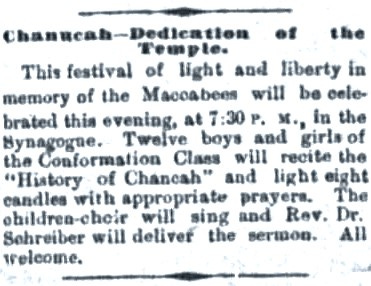
This seemingly innocuous piece, brought to light recently by Paul R. Spitzzeri, director of the Homestead Museum, may be the first mention of the Festival of Light in the area’s press.
Appearing in the December 2 edition of the 1885 Los Angeles Herald, it records the observance of “Chanucah” at Congregation B’nai B’rith, the first synagogue in Los Angeles.
Like the holiday, it illuminates so much. Jewish boys and girls were celebrating the holiday together as equals both in presentation, song and prayer. Choral music was an important part of the celebration, and a sermon looks to have been established as part of the synagogue’s observance.
The late 19th century reference to “Chanucah” as a “festival of light and liberty” connects us to our own struggle in the 21st century for spiritual connection and religious freedom.
Finally, this “Chancah“ piece establishes a long-standing tradition of the American press of misspelling, and later mispronouncing Hebrew words.
To read more of Paul Spitzzeri’s fine piece on “The Celebration of Hanukkah in Los Angeles, 1885-1900” click HERE.
////\/\\\\
*LIVE FROM THE ARCHIVE:
A social realism menorah
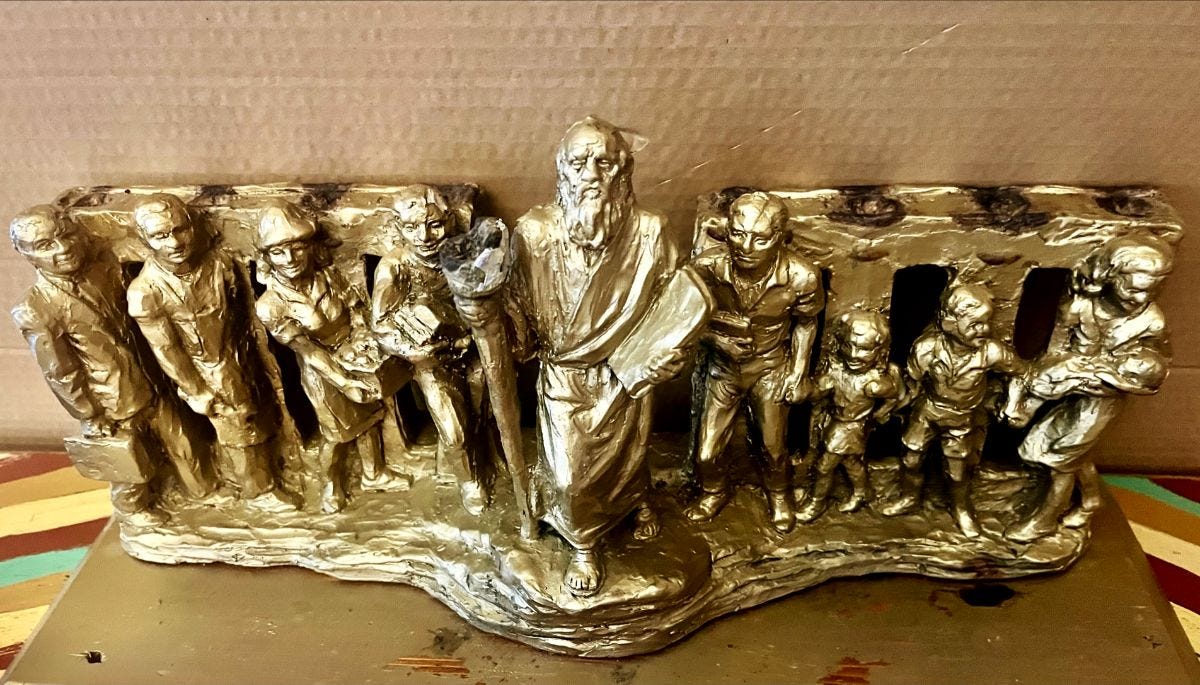
This Chanukah menorah was made in Los Angeles by artist David Kaplan in a style not usually associated with Judaica.
On one side, the figures, a man with briefcase (a lawyer working for social justice?), a factory working holding a wrench, a woman bearing a crate of fruit, a student with books, all bearing the rumpled heroic look of social realism.
Completing the look, on the other side is a family (Israeli?) holding hands: a dad with a book under his arm, two young children, and a mom with baby. All look robust, and ready to step into the light of a future lit by Moses, the shamash, bearing a torch in one hand, and the tablets of the law in the other.
Molded in 1969, in his studio/showroom In Van Nuys, the Chanukiyah was created from a soft material called chalkware (plaster of Paris), often used for casting figurines.
Sometime during its existence, the owner painted the piece gold and mounted it on a piece of wood. Burn marks in the candle holders show it has been used for many years.
In 1971, while introducing a set of figures Kaplan had created based on “Fiddler on the Roof,” The LA Times described Kaplan as “Talented, young” and from a “Russian Jewish background.”
*The Rodman Archive of Los Angeles Jewish History is a collection of approximately 2000 objects, photos, clothing, art, books, recordings, and ephemera relating to the lives and endeavors of Jewish Angelenos between 1850 and 1980.
////\/\\\\
Seen on the way: Farmers Market
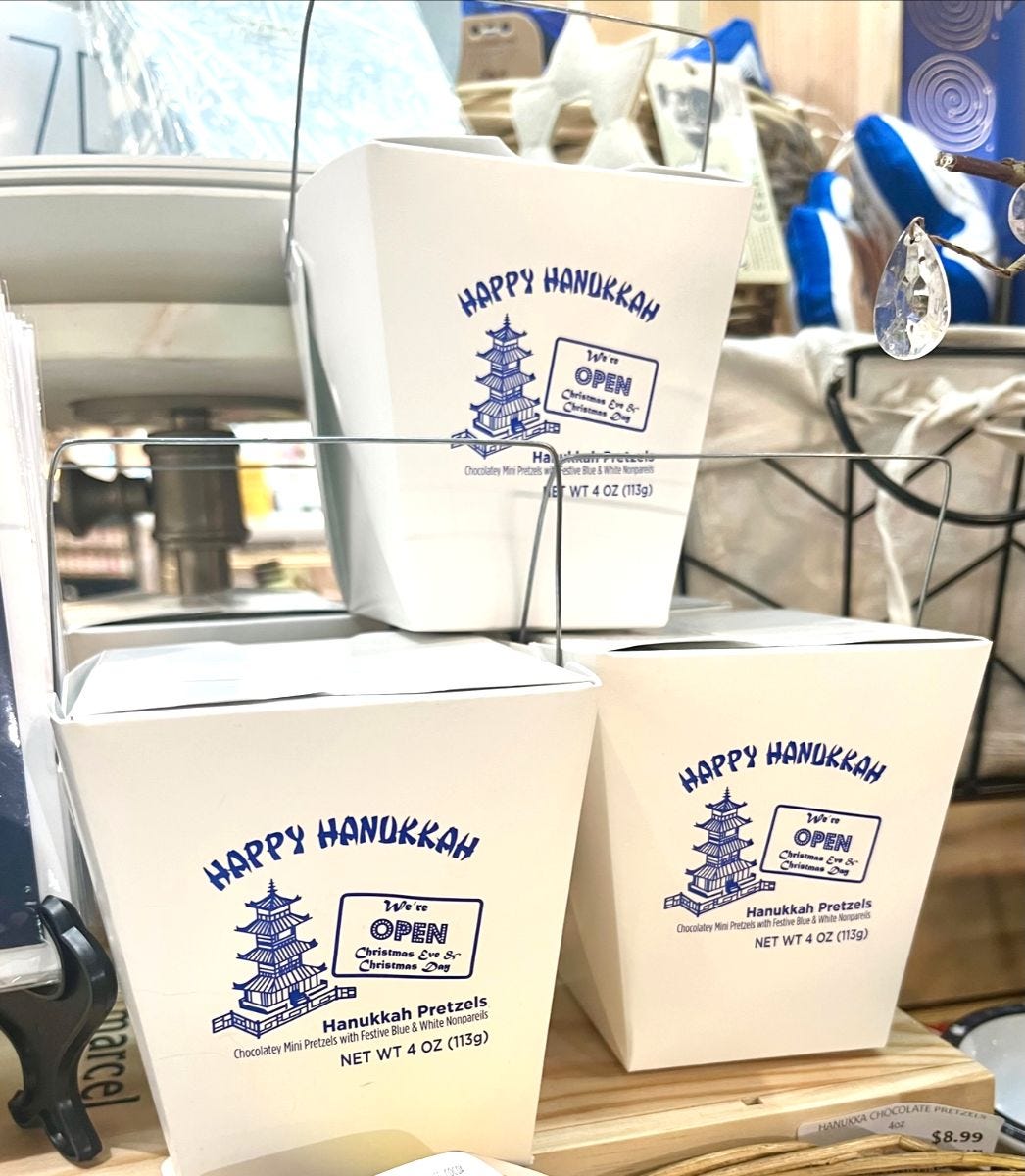
The “Hanukkah” Chinese takeout container hits a sweet spot of Jewish cultural tradition. Filled with chocolate covered mini pretzels sprinkled with blue and white nonpareils, the carton evokes an appetite for both food and cultural connection. The carton, produced by Nassau Candy since 1917, connects us to the Jewish tradition of eating Chinese food on Christmas Eve, a time when we seem to get particularly hungry, feel a little isolated, and most restaurants are closed. The contents remind us of our continuing appetite for a salty, twisted snack brought to America with the immigration of German Ashkenazi Jews. Baking it all together are the blue and white sprinkles, a nod to the unofficial-official colors of our festival of dedication, Chanukah.
////\/\\\\